
11 Facts About Bats
Explore why these secretive night fliers surprise us by learning 11 amazing facts about bats, from their echolocation skills to their significant function in ecological systems.
FACTS ABOUT
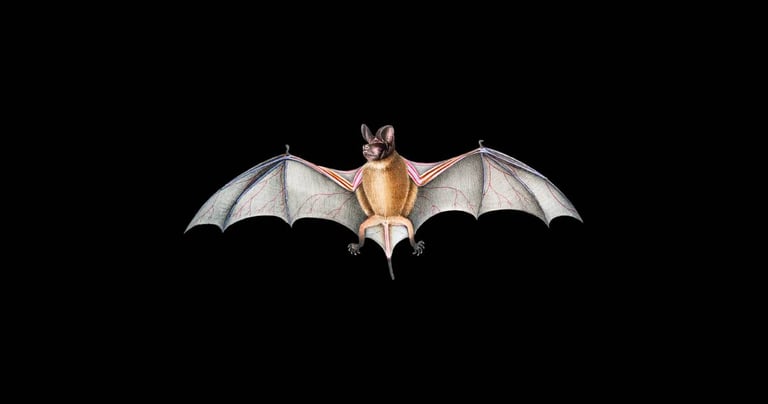
Bat (credit: pixabay)
To be straightforward, I tended to get scared of bats. My gut would squeeze at the sight of those fleeting shadows moving across a streetlight. However, as I gained more knowledge, that anxiety gradually gave way to excitement. These microscopic airborne acrobats silently preserve crops, sustain ecosystems, as well as assist in the recovery of damaged forests. Nevertheless, they hardly receive the credit they are worthy of. If you have ever been uncomfortable with bats or are just inquisitive, these 11 facts will make you appreciate them even more.Allow us to examine these unexpected animals from the perspectives of useful knowledge, individual interest, and a hint of amazement.
Bats Can Live Over 40 Years: When I first learnt this, I was surprised. You might believe that a small animal with a rapid heartbeat could not thrive for a lengthy time, but several species live more than 40 years. It appears unattainable, much as when you anticipate your smartphone's battery to survive for a week. They are among the longest-living mammals in relation to their size because of their lifespan.
Bats Are The Only Mammals Capable of True Flight: Squirrels in flight glide. Bats flap. Compared to other mammals, they fly similarly to birds. They can explore huge territories each night and hunt insects with accuracy thanks to this capacity. They move with remarkable speed, as you can see if you have ever seen one zigzag around a porch light.
Bats Have Wings Made of Modified Hands: A hand-like shape can be seen if you examine a bat's wing up close (ideally in a picture; you do not have to approach it too close). Their wings, which are covered with thin skin, extend over lengthy finger bones. It resembles putting on an elastic glove that goes past your fingertips.
Bats Use Echolocation With Incredible Precision: Human technology is dwarfed by bat echolocation. Certain animals are able to identify things that are thinner than a hair. Probably I would not crash into furniture during late-night fridge invasions if I had this ability. They can locate insects, avoid branches, and penetrate dark caverns because of this incredibly precise sound mapping.
Bats Eat up to Their Body Weight in Insects: Insectivorous bats are excellent at controlling pests. In just one night, a bat can eat thousands of mosquitoes and bugs that harm crops. Farmers gain a great deal, regardless of whether they are unaware that they are receiving labor at no cost from the sky. Understanding this may increase your appreciation for bats the following summer if you live in a mosquito-prone location.
Bats Play a Major Role in Pollination: Several popular foods, such bananas, mangoes, and agave, rely on bats for pollination. Both wild ecosystems and agricultural systems benefit from their activities during the night. The goods at the grocery store would appear considerably different without them.
Bats Can Fly in Complete Darkness: They can go through completely dark areas without running into cave walls thanks to their echolocation. While individuals find it difficult to navigate a dimly lit passageway, bats effortlessly navigate complicated subterranean environments.
Bats Have Surprisingly Strong Immune Systems: This is the point at which matters become somewhat fascinating. Because of their special immune systems and capacity for DNA repair, bats are capable of carrying viruses without becoming sick. In an effort to figure out how these characteristics might lead to more effective medical interventions, scientists closely examine them.
Bats Rarely Get Cancer: Their cells have remarkable tumor-suppression and DNA repair capabilities. Picture having a cleaning team that consistently arrives on time. These characteristics may eventually lead to advances in medical science, however study is still proceeding.
Bats Help Forests Regenerate: Fruit bats spread seeds over a wide area. Bats assist forests regenerate by dispersing seeds into arid areas following the destruction of vegetation by storms or wildfires. They operate above the treetops like unspoken gardeners, if you will.
Bats Can Run on The Ground: For instance, vampire bats have developed a hopping-running action that uses their wings in a manner similar to that of forelimbs. It appears strangely athletic, comparable to a small animal preparing for a track competition. They are capable of approaching prey quickly and secretly thanks to this adaption.
Helpful Guidance For Respecting & Encouraging Bats
Listed below are some easy actions you might consider to help these vital animals if you are currently experiencing a greater appreciation than worry:
Build a bat house in your backyard. It assists in natural management of insects.
Keep native plants intact. For pollination, the majority rely on bats.
Minimize the use of pesticides. Healthy bat populations are supported by healthy insect populations.
Safeguard surroundings at night. Bat activity is disturbed by excessive artificial light.
Little adjustments can have a significant impact.
Summary: Wonders Hidden in The Dark
Bats might appear enigmatic, however immediately you figure out their significance, they are far from scary. They play a significantly greater part in ecological systems than many individuals know, from sustaining global agriculture to living remarkably long lives. As I was writing this, I experienced that well-known transition once more, from reluctance to appreciation, and hopefully you did too. The above 11 facts show you how amazing bats are if you have ever had trouble seeing them as anything more than frightening night-time figures. Who is aware? You may even get a little excited the following time you notice one soaring across the skies.
